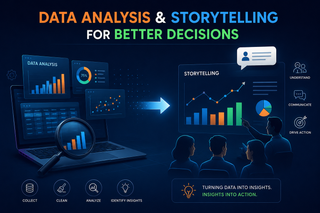
Data Analysis, Storytelling & Decision-Making
How modern organizations transform raw data into clarity, confidence, and measurable business impact.
Executive Summary
This article presents a comprehensive view of how data analysis, when combined with strong business understanding and storytelling, becomes a strategic asset rather than a reporting function. Through real-world scenarios, analytical thinking frameworks, and decision-driven examples, we explore how organizations move from data overload to actionable insight.
1. The Illusion of Being “Data-Driven”
Most modern organizations proudly describe themselves as data-driven. Dashboards are everywhere. KPIs are tracked daily. Reports are generated automatically.
Yet, when critical decisions arise, conversations often shift from data to instinct, seniority, or urgency.
This contradiction exists because having data is not the same as understanding data.
Data does not create value by existing. Value appears only when data changes decisions.
2. What Data Analysis Actually Means in Practice
In theory, data analysis is often explained as a sequence of steps: collect data, clean it, analyze it, visualize it.
In practice, it is a much more iterative and human process.
A data analyst constantly moves between three questions:
- What is happening?
- Why is it happening?
- What should change because of this?
Tools like SQL, Python, or BI platforms help answer parts of these questions, but they never replace reasoning.
3. The Invisible Work: Cleaning and Shaping Data
One of the least visible but most critical parts of data analysis is data preparation.
Real-world datasets are messy by default. Missing values, inconsistent formats, duplicated records, and incorrect entries are common.
Analysts often spend 60–70% of their time preparing data before any meaningful analysis begins.
This work rarely appears in presentations, but without it, insights become unreliable.
4. From Metrics to Meaning
Metrics alone rarely tell a complete story.
For example, an average revenue figure may look stable, while underlying customer behavior is changing rapidly.
Without segmentation, trends remain hidden. Without context, numbers remain abstract.
Insight is not about knowing more numbers. It is about knowing which numbers matter.